Discover beauty with our exclusive discounts!

6 Tips to Transform Underwater Photography Through Black and White: A Journey Beyond Colour into Deeper Meaning (Part 1)
Transform your underwater photography with black and white techniques that reveal deeper stories. Learn 10 expert tips from a marine biologist with 32 years diving experience to create compelling monochrome images that bridge the gap between what you capture and what viewers feel. Discover how contrast, texture, and philosophical approach can elevate your underwater imagery beyond technical perfection.
Michael Markovina
9/23/20258 min read

A Personal Journey
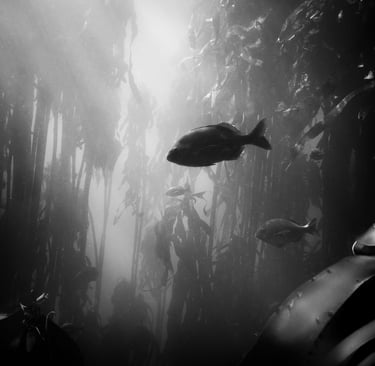
With over 32 years of diving experience and more than 15,000 underwater hours logged on scuba (most likely more freediving), I have explored some of the planet's most extraordinary underwater realms, from the remote locations scattered throughout Africa to the mystical fjords of Norway, from the hidden sea caves of Portugal to the vibrant tropical reefs of East Africa, from the towering kelp forests of South Africa to the pristine waters of Lake Baikal in Russia, and countless other places that have shaped my understanding of the underwater world.
As a fisheries biologist, I've been privileged with access to locations and perspectives that many never see. Throughout every dive, every expedition, every moment of wonder beneath the surface, my camera has been my constant companion. My journey in photography continues to evolve; I'm still learning, still discovering, but what has fundamentally changed through decades of field experience isn't just technical capacity. It's learning how to let an image become an extension of a greater story, a window into something deeper than the moment itself.
These 10 tips represent a process I've lived through, lessons learned not in studios or classrooms, but in the wild, unpredictable theatre of the ocean. I hope they open new ideas and avenues for exploration in your own photographic journey.
To clarify, I don't have top-of-the-line camera equipment. I don't even own a strobe. I work with two small video lights, a broken housing with an acrylic dome (not glass), and an old camera. Yes, I'm desperately hoping to upgrade someday, but that's no excuse to avoid creating incredible images that define your narratives. These images should serve as mirrors to your current being, reflecting where you are in your journey at that time.
You just must get out there and start.
First, let’s address the elephant in the room: criticism. You'll share an image that captures exactly what you felt in that underwater moment, and inevitably someone will say, "You should have..." or "Maybe next time you could..." or "Your edit is very dark," or "If only the image had better leading lines or depth of field." Learn to distinguish between positive criticism and ignorance.
But before you get grumpy and upset (as tempting as it is), stop. Take a deep breath. Your photos are good enough (sure, technically we can always improve, but this is not the point I’m trying to make). In fact, your images are more than good enough; they're yours, they're authentic, and they capture something that many critics have never seen, never felt, or never experienced.
The challenge is that people see your images, but they don't necessarily see your story. There is a disconnect. An image should convey its meaning through its composition, style, and aesthetic, allowing anyone to derive their own personal attachment to that meaning from the viewing experience.
Art is subjective. Your image speaks to you because it captures your experience, your interpretation, your moment of connection with the underwater world. That's not just valid, that's the entire point. Don't take criticism personally because it's not about you; it's about the gap between your vision and their understanding.
Using Artistic Expression Purposefully: This doesn't mean we ignore all feedback or stop growing as photographers. But instead of changing your vision to please others, consider how you might better express your narrative. Maybe that "too dark" edit perfectly captures the mysterious feeling of depth. Maybe those "imperfect" leading lines mirror the chaotic beauty of marine life. Maybe that "unconventional" composition reflects exactly how that moment felt to you.
The question isn't "How can I make this image meet everyone's expectations? The question is "How can I better express what this moment meant to me?
Your underwater experiences are unique. Your perspective is valuable. Your story matters. Don't let anyone convince you otherwise.
The Philosophy of Monochrome: Discovering Truth in Silence
In the realm of underwater photography, colour often captivates us first. I mean, why not? It's stunning: the vibrant blues of deep water, the brilliant yellows of tropical fish, and the vibrant corals like an aquatic rainbow. Yet beneath this chromatic symphony lies something more profound, more timeless. When we strip away colour and embrace the monochromatic world of black and white, we don't lose beauty; we discover it anew.
Black and white underwater photography invites us into a philosophical realm where dualities complement, light and shadow, presence and absence, the known and the mysterious. It's here, in this space between extremes, that we find the poetry of interpretation.
This philosophical foundation leads me naturally to black and white underwater photography. When we remove colour from underwater scenes, we perform an act of reduction that paradoxically reveals more. Like a sculptor chiseling away marble to reveal the figure within, we strip away the obvious to expose the essential.
In Eastern philosophy, the concept of yin and yang teaches us that opposites are not contradictory but complementary. Black and white photography embodies this wisdom; it reveals that meaning often emerges not from what we include, but from what we choose to leave out.
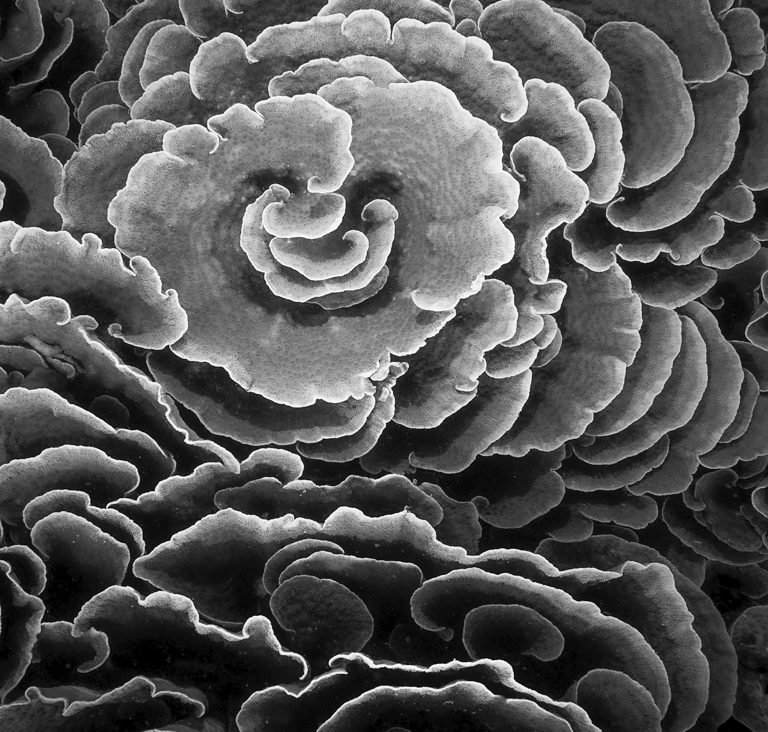
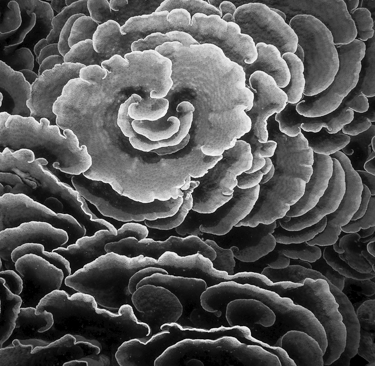
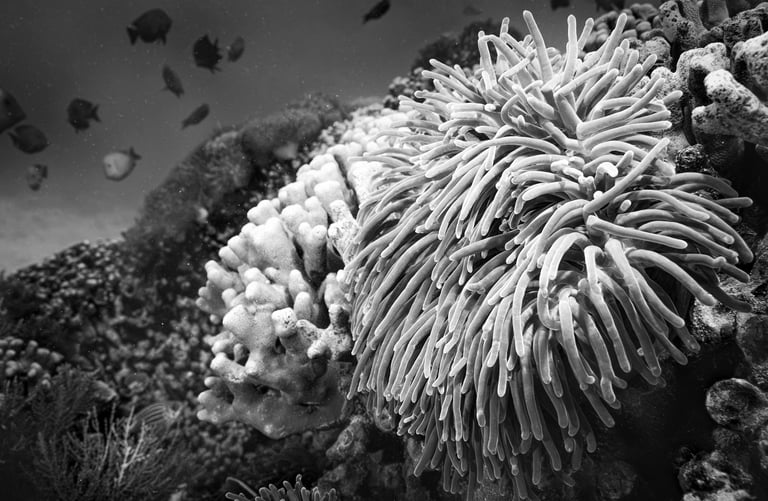

3. Texture: Let Surfaces Speak
Underwater environments offer an incredible variety of textures, such as the smooth curve of a ray's wing, the rough, bark-like surface of coral, and the flowing, silk-like appearance of waving kelp forests. In black and white, these textures become characters in your narrative.
Technical Approach:
Use side lighting to enhance texture definition
Focus on tonal gradations within textures (why photographing in colour is important)
Experiment with different angles to reveal hidden surface patterns
Deeper Meaning: Texture in black and white photography becomes a language of touch translated into sight. It invites viewers to imagine the sensation of these underwater surfaces, creating a more intimate connection with the image.
4. Reduce Distractions: The Power of Negative Space
Underwater environments can overwhelm viewers with visual noise. When converting to black and white, every distraction becomes more apparent because you can't rely on colour to guide the eye. The question becomes ruthless: What truly serves your story? In addition to colour, noisy backgrounds, multiple subjects, edge anomalies, tonal confusion and particle matter in the water can all distract from the image aesthetic. (Note, sometimes distractions can be advantageous, it's all about your interpretation and creativity on the shoot).
Strategic Simplification:
Use depth of field to isolate subjects, f2.8 as opposed to f11, for example, depending on the shot/subject, etc.
Embrace negative space as an active compositional element
Remove busy backgrounds through positioning and lighting (angle lighting as to avoid illuminating the front side of particular matter)
Focus on single subjects or simple relationships between elements
The Minimalist Mindset: For truly minimalist underwater images, ask yourself: "If I removed this element, would the image still tell the same story?" If yes, remove it. Minimalism isn't about empty frames; it's about maximum impact with minimum elements.
Philosophy of Reduction: This mirrors meditation practices where we quiet the mind's chatter to hear deeper truths. In photography, reducing visual noise enables you to convey your message more clearly. Every element that remains must earn its place in the frame.
Let's explore the first 6 tips:
1: Know Where You Are in Your Photography Journey
Where are you in your photography? Are you chasing the "perfect" image, or are you telling a story through artistic expression?
As a young explorer and underwater photographer, I was captivated by the pursuit of technically flawless images, perfect light, perfect moments, perfect compositions. But what is perfect? As Alan Watts reminds us, nature itself is "pointless"; it simply is, without striving for some external standard of perfection. There cannot be an inside of a box without an outside; in other words, you are not separate from the environment, you are one, just like perfection lives intrinsically with imperfection, each giving meaning to the other.
This realisation transformed my approach entirely. I began to understand that not necessarily the most technically optimal photography had the most interesting story. Now, as an older photographer, I look for meaning first, wondering how an image can express something more profound. It could be a personal memory, a connection on a deeper level, or something a friend said that moved you. Think of it like poetry, an art form that tries to explain the unexplainable. The tools of photography, contrast, texture, light, and shadows, are simply that: tools. But the fundamental question remains: What story are you trying to tell? What meaning are you seeking to express?
Lesson: Look inward to express outward.
2. Master the Art of Contrast: Your Primary Language
Underwater, contrast becomes your vocabulary. The interplay between the deepest blacks and the brightest whites creates a visual tension that colour can sometimes obscure.
Practical Application:
In shallow water, shoot during morning/afternoon when surface light penetrates water at an angle, thereby increasing drama with softer tones and higher contrast.
Position subjects against darker backgrounds to create separation
Use strobes strategically to illuminate foreground subjects while maintaining darker backgrounds (for me, no strobes, I shoot at lower ISOs typically, creating a darker image, then with a video light, I can dim the light for a specific subject, creating high contrast scenes, it’s hard when free diving)
Embrace silhouettes, they often tell more powerful stories than fully lit subjects (silhouettes allow interpretation from viewers easily, as they are generally minimalistic, with often a central subject or an iconic subject like a shark).
Shoot in colour but shoot in colour with the intention of a black and white edit. Here is why: Red and green might appear similar in black and white, but having the original colour data gives you control over their tonal separation. Using colour-specific adjustments in post-production (e.g., darken blues to make water more dramatic while keeping the subject lighter) gives you an edge.
Deeper dives, +15m, especially in reduced visibility, external lighting is important to separate subject from background; however, silt, sand, “marine snot” as we call it, can illuminate with light angled incorrectly, giving your image a dirty look. I can write up lighting tricks another time.
Philosophical Insight: In photography, think of contrast as a mirror to life's fundamental tensions. Joy gains meaning from sorrow, or presence from absence. In your underwater black-and-white images, these visual contrasts invite viewers to contemplate these deeper polarities subconsciously.
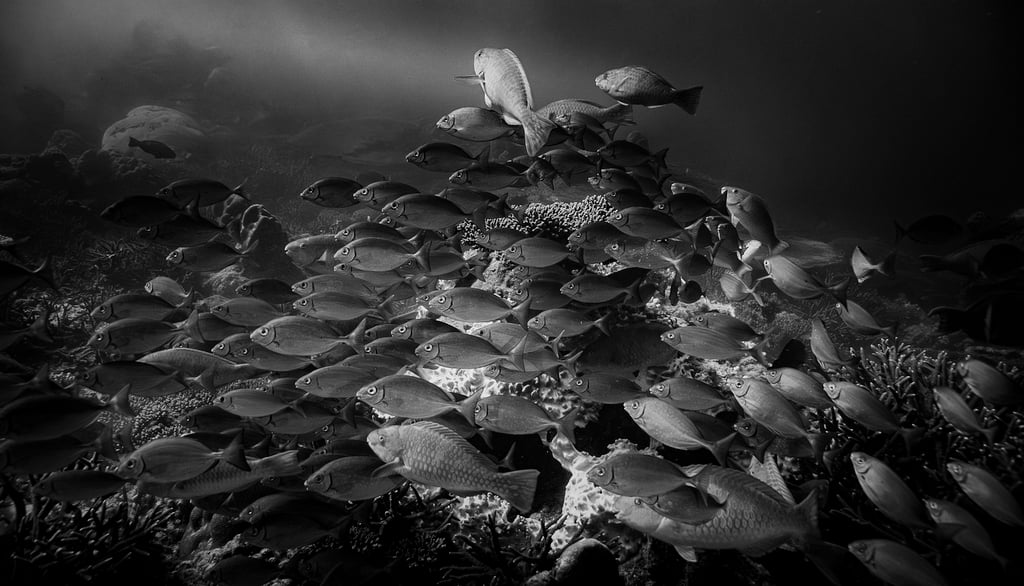
5. Capture Movement in Stillness
Water is movement incarnate, yet a photograph freezes time. Black and white underwater photography challenges you to capture the essence of motion within stillness, the implied movement of currents, and the continuous motion of marine life.
Technical Mastery:
Experiment with different shutter speeds to control motion blur. Try flash/ambient balance or drag shutter (fast flash, 1/1000s, to freeze your subject, then slow shutter to create motion blur). This works great with Black and White imagery
Use leading lines created by current patterns or schools of fish
Capture the decisive moment when movement peaks (a shark turning at speed, or a fish school suddenly changing direction – showing implied motion).
Consider the emotional weight of frozen versus “flowing” elements. Remember everything is in motion, don’t mistake motion for poor focus.
Temporal Philosophy: Black and white images possess an inherent timelessness. By capturing movement in monochrome, you create images that could have been taken decades ago or might be taken decades from now, connecting past, present, and future in a single frame. I will dedicate my photographic journey to capturing motion and light underwater; it is truly a magical narrative in photography.
6. Work with Natural Light Patterns
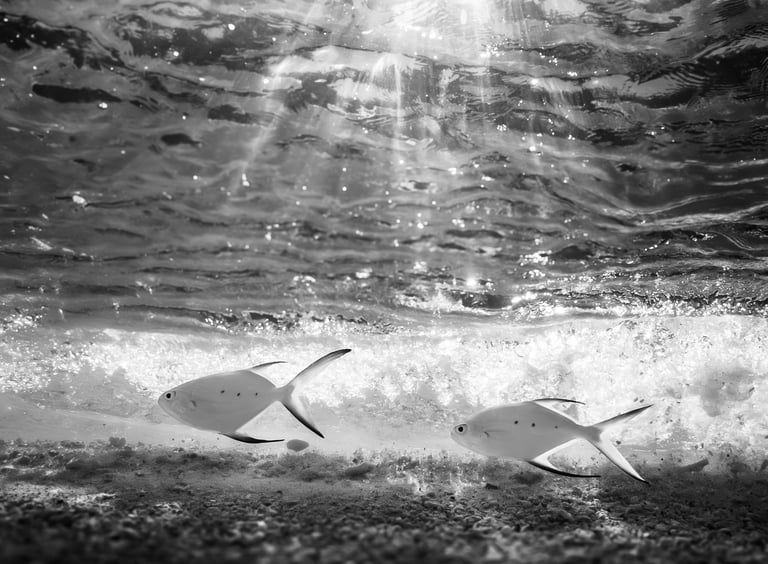
Underwater light behaves differently from terrestrial light, creating unique patterns, sunbeams (light rays), and caustics that dance on the seafloor, as well as the gradient from the bright surface to the mysterious depths. Note light differs dramatically from the shallow 2-10m towards the deeper 15 – 30m. Visibility also plays a crucial role, so there are many things to consider (I could write a novel on this alone).
Light as Subject:
Make light rays themselves compositional elements
Use the water column's natural gradients as backgrounds
Capture the interplay between artificial (strobe) and natural light
Embrace the mysterious quality of diminishing light with depth
Symbolic Illumination: In black and white underwater photography, light becomes a metaphor, representing knowledge emerging from mystery and consciousness rising from the unconscious depths of the sea.
End of part 1: