Discover beauty with our exclusive discounts!

Black and White Underwater Photography: Creating Dramatic Fine Art
Discover how black and white transforms underwater fine art photography into powerful storytelling. Walk through Mike's process of interpreting a shark image and using fine art tools to create dramatic marine narratives.
Mike Markovina
9/28/20254 min read
From Documentation to Drama: The Art of Emergence in Underwater Photography
How stripping away colour can reveal the soul of a story
These are my experiences and my approach to storytelling through underwater imagery. What I share here is not meant to be rigid rules to follow, but rather one photographer's perspective on creative possibilities. The guidelines are yours to interpret and modify as you see fit. My hope is to offer new ways of looking at things and inspire exploration in your own art and creative process
The Problem with Pretty Pictures
We've all seen them, those vibrant underwater photographs bursting with tropical blues and rainbow-hued coral gardens. They're undeniably beautiful, but beauty alone doesn't always tell a story. Sometimes, the very elements that make an image "pretty" can dilute its narrative power.
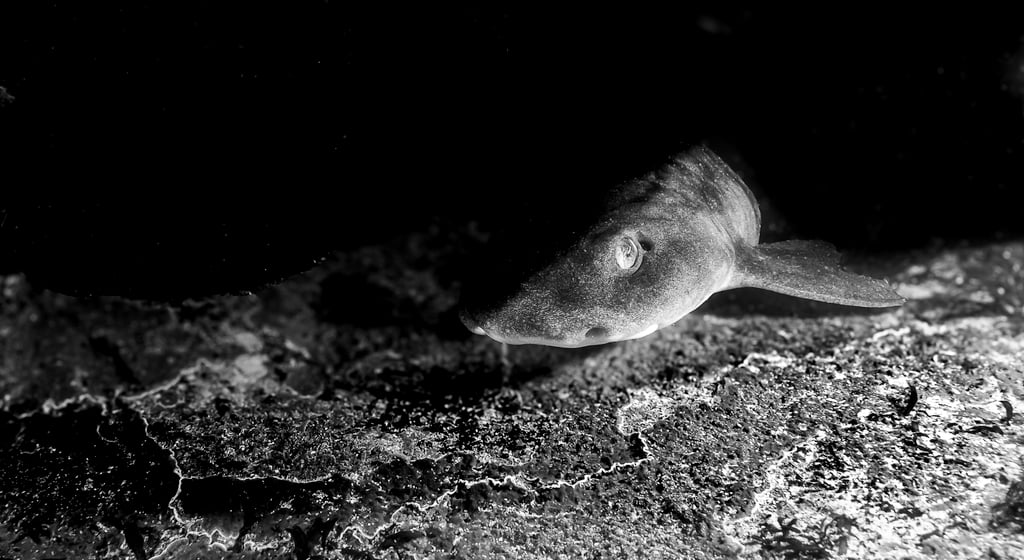
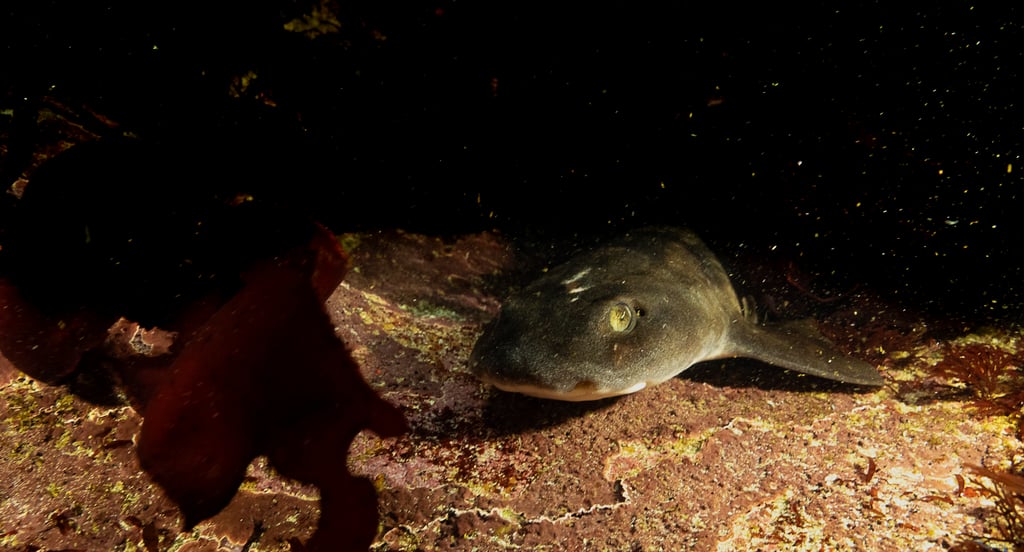
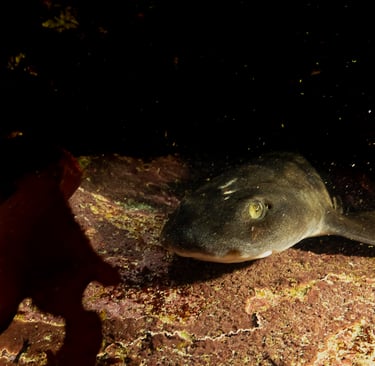
Take the dark shyshark emerging from the kelp forest. In full colour, we see the rusty browns of the kelp, the mottled greys and tans of the shark, the deep green-blue of the water. It's a nice nature photograph. But does it capture the essence of what this moment really represents, that heart-stopping instant when a predator materialises from the shadows?
The Language of Light and Shadow
Fine art photography has long understood something that underwater photographers are only beginning to embrace: sometimes you must subtract to add impact. By converting to black and white and dramatically enhancing the contrast, we're not only changing the aesthetic but also altering the entire emotional register of the image. These images are not trying to win photographic awards; they are an interpretation of an experience through artistic expression.
The transformation reveals three distinct zones of narrative tension:
The Textured Foreground: The rocky substrate becomes a stage, its rough texture catching and scattering light like a theatrical backdrop. This detailed, high-contrast foundation anchors our eye and provides context. This is the shark's domain, harsh and unforgiving.
The Emerging Subject: Stripped of colour distractions, the shark's form becomes pure sculpture. Its smooth curves contrast dramatically with the textured environment, while strategic lighting emphasises that piercing eye, the moment of recognition between predator and observer. The eye is key in this image, as it is when we, both shark and photographer, visually meet: one comfortable and natural, the other, holding its breath, confined in a wetsuit mask on its face, looking quite alien to the other.
The Void: Perhaps most importantly, the background dissolves into inky blackness. This isn't just empty space; it's the unknown, the mystery from which danger emerges. It's every childhood fear of dark water, unseen threats, and surprises. By creating a deep, dark background, I am trying to evoke that sense of fear, let's say when you are swimming in deep water and your mind plays tricks with monsters arriving from the depths. It is an unsettling sense and one I wanted to convey. Ultimately, it is only through darkness that we understand light, only through space that we understand matter.
Technical Tools for Emotional Impact
This transformation didn't happen by accident. Here are the specific techniques that amplify the narrative:
Contrast Enhancement
Increase blacks to create true void areas, blur the background effect to create an inky soft feeling
Lift highlights selectively on the shark's form and eye, and darken the natural texture lines to create a “pop” effect of the shark
Use masking to control contrast in different zones independently, by shooting in colour you have access to the full tonal range in your edit
Texture Emphasis
Apply clarity/structure to the foreground elements, only slightly, don’t make it unreal, the angled light in the shot has already created the drama, just show it
Use graduated filters to separate depth planes. This works well with a light blur on the background
Maintain detail in mid-tones while pushing extremes in the whites and blacks to create strong contrasts
Selective Lighting
Dodge the shark's eye to create that piercing focal point
Burn the background to eliminate distracting elements
Create a subtle rim light effect to separate the subject, and feather masks so the lines are not sharp and distracting
Beyond the Shark: Universal Principles
This approach works for any subject where emergence, revelation, or transformation is part of the story:
Eels emerging from crevices: Use deep shadows to make the crevice feel infinite
Fish breaking through thermoclines: Emphasise the contrast between water layers
Divers in overhead environments: Let the darkness suggest vastness and danger
The Courage to Strip Away
The hardest part of this process isn't technical, it's psychological. We're conditioned to think that underwater images should showcase the ocean's colour palette. But sometimes, the most honest representation of an underwater experience isn't about what we see, but about what we feel. Also, don’t feel restricted by the idea that your image must be perfect out of the camera; you are not trying to win a photographic contest, you are creating a story from an experience that someone can relate to when the image is hanging in their space. Be bold, be creating, let the story guide you.
That moment when a shark appears from nowhere isn't really about the coral colours or water clarity. It's about primal recognition, about the sudden shift from being an observer to being observed. It's about emergence from the unknown.
Your Story, Your Tools
Every underwater encounter has an emotional core. Before you reach for the saturation slider or start boosting those blues, ask yourself: what is this image really about? What was the feeling of this moment?
Then have the courage to use every tool at your disposal, including the radical act of subtraction, to serve that story. Your viewers will feel the difference, even if they can't articulate why.
Diving Deeper into Monochrome Mastery
This exploration of narrative-driven black and white conversion is just one approach in the broader world of monochrome underwater photography. For more on black and white underwater technique and philosophy, be sure to read "6 Tips to Transform Underwater Photography Through Black and White: A Journey Beyond Colour into Deeper Meaning (Part 1)", where we cover the essential technical and creative foundations.
And to explore the artistic philosophy behind why black and white can be so powerful underwater, dive into "Monochrome Depths: The Art of Black and White Underwater Photography" for insights into how removing colour can actually reveal more about the underwater world than colour ever could.
Because sometimes, to show everything, you first have to take everything away.