Discover beauty with our exclusive discounts!

The Science Behind Why Ocean Art Calms Your Mind
Marine biologist Mike Markovina explores the scientific reasons behind ocean art's powerful calming effects. Drawing from neuroscience research, evolutionary psychology, and decades of underwater fieldwork, this post reveals why blue imagery reduces stress hormones, how natural fractals promote visual flow, and why our brains are evolutionarily programmed to find water environments peaceful. Learn the practical applications for choosing ocean art that scientifically supports relaxation and well-being in your living space.
Mike Markovina
9/13/20253 min read

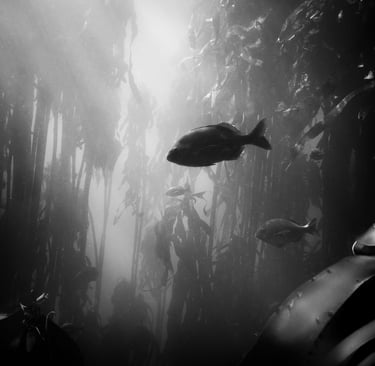
Standing before a piece of ocean art in a gallery or living room, most people experience an immediate sense of calm. Their breathing slows, shoulders relax, and stress seems to ebb away like a retreating tide. But why does ocean imagery have such a profound effect on our mental state? The answer lies in a fascinating intersection of evolutionary biology, neuroscience, and our primal connection to water.
The Evolutionary Blueprint
Our brains are hardwired to find water environments calming, a trait rooted deep in evolutionary history. For millions of years, proximity to water meant safety, fresh drinking water, abundant food sources, and protection from predators. This evolutionary programming, sometimes called "blue mind" by marine biologist Wallace J. Nichols, explains why we instinctively feel peaceful around water environments.
When we view ocean art, our brains activate the same neural pathways triggered by actual proximity to water. The amygdala, responsible for stress responses, shows decreased activity, while the parasympathetic nervous system, our "rest and digest" mode, becomes more active.
The Neuroscience of Blue
Color psychology research reveals that blue hues specifically reduce cortisol levels and blood pressure. Ocean blues trigger the release of calming neurotransmitters like serotonin and dopamine. In my underwater photography, the monochromatic blue-grey tones aren't just aesthetic choices; they're scientifically proven stress reducers.
Studies using EEG (electroencephalography - what a word) brain imaging show that viewing blue environments increases alpha brain waves associated with relaxation and creativity while decreasing beta waves linked to anxiety and overthinking. This is why hospitals increasingly use ocean imagery in patient rooms and why meditation apps feature ocean sounds.
Fractals and Visual Flow
Ocean art often contains natural fractal patterns, repeating geometric shapes found in waves, coral structures, and underwater formations. Research by neuroscientist Richard Taylor demonstrates that humans find fractal patterns inherently calming because they mirror the mathematical structures our visual cortex evolved to process efficiently.
When I photograph coral formations or capture the fluid movement of marine life, these natural fractals create what researchers call "visual flow", a state where the mind processes imagery effortlessly, reducing cognitive load and promoting relaxation.
The Mirror Neuron Effect
Our brains contain mirror neurons that fire both when we perform an action and when we observe others performing the same action. When viewing underwater photography or marine life imagery, these neurons activate as if we're experiencing the weightless, flowing movement of underwater environments ourselves.
This neurological mimicry explains why people often describe feeling "immersed" or "transported" when viewing compelling ocean art. The brain literally simulates the calm, meditative experience of floating underwater.
Biophilia and Ocean Connection
Biologist E.O. Wilson's concept of biophilia suggests humans have an innate affinity for life and living systems. Ocean art taps into this deep biological connection, reminding us unconsciously of life's origins in primordial seas.
Marine environments represent the ultimate expression of natural rhythms, tidal cycles, seasonal migrations, and the eternal dance of predator and prey. When we view ocean art, we connect with these fundamental life patterns, synchronizing our own rhythms with nature's ancient cadences.
The Science of Attention Restoration
Environmental psychologist Rachel Kaplan's Attention Restoration Theory explains why natural imagery helps mental recovery. Ocean scenes provide what researchers call "soft fascination", engaging our attention without requiring focused effort, allowing directed attention mechanisms to rest and restore.
Unlike urban environments that demand constant vigilant attention, ocean imagery offers the mind permission to wander, dream, and decompress. This cognitive restoration is measurable through improved performance on attention-based tasks after viewing natural scenes.
From Research Station to Living Room
During decades of marine research, I've witnessed this calming effect firsthand, not just in myself, but in research teams working under intense pressure. The simple act of observing marine life, whether through a diving mask or a photograph, consistently shifted group dynamics from stressed to contemplative.
This personal observation aligns with clinical research showing that patients recover faster when their rooms contain nature imagery, particularly water scenes. The therapeutic value isn't just aesthetic, it's neurological.
Practical Applications
Understanding the science behind ocean art's calming effects has practical implications for choosing artwork for your space:
For Meditation Areas: Monochromatic ocean imagery with minimal detail allows for soft focus and mental wandering.
For Workspaces: Underwater scenes with gentle movement patterns can provide brief attention restoration breaks during demanding cognitive tasks.
For Bedrooms: Deep blue tones naturally trigger melatonin production, supporting healthy sleep cycles.
For Healthcare Settings: Research consistently shows ocean imagery reduces patient anxiety and pain perception.
The Marine Biologist's Perspective
My transition from marine research to fine art photography wasn't just a career evolution; it was recognition that the calming power of ocean imagery deserves scientific documentation. Every underwater photograph I create carries decades of field observation about how marine environments affect human consciousness.
The weathered shells, the flowing movement of sea life, the play of light through water, these aren't just beautiful subjects. They're visual triggers for some of our most fundamental neurological relaxation responses.
When you feel your stress dissolve while viewing ocean art, you're not imagining it. You're experiencing millions of years of evolutionary programming, sophisticated neuroscience, and the profound connection between human consciousness and the sea that gave us life.