Discover beauty with our exclusive discounts!

Underwater Photography: Colour to Black and White Shark Images (Before/After)
Learn underwater photography editing and shot planning tips with this pyjama catshark before/after comparison. See how colour-to-monochrome conversion reveals marine biology secrets and improves composition.
Mike Markovina
9/26/20255 min read
My post content
Visual Storytelling Underwater: The Photography Technique That Reveals Shark Adaptation
Sometimes the most powerful wildlife images aren't about showing everything; they're about revealing something unexpected.
When Composition Tells a Biological Story
This striking black and white image does more than document a striped pyjama catshark shark (Poroderma africanum); it visually narrates millions of years of evolutionary adaptation. Every compositional choice here serves both artistic and educational purposes, creating a photograph that teaches us as much about survival as it does about seeing.
The Power of Monochrome: A Tale of Two Visions
The Technical Choice: Converting to black and white wasn't arbitrary; it was a strategic decision. But here's the crucial insight: shooting in colour with a black and white intention allows you to capture the full tonal range, which will translate powerfully in post-processing. In the original colour image (the colour image is actually the second image in the sequence), we see the pyjama catshark's natural blue-grey colouration against warm, red-orange rocks and green kelp forest algae. The colours are beautiful, but they compete for attention. The eye wanders between the vibrant rock textures, the algae patterns, and the shark itself.
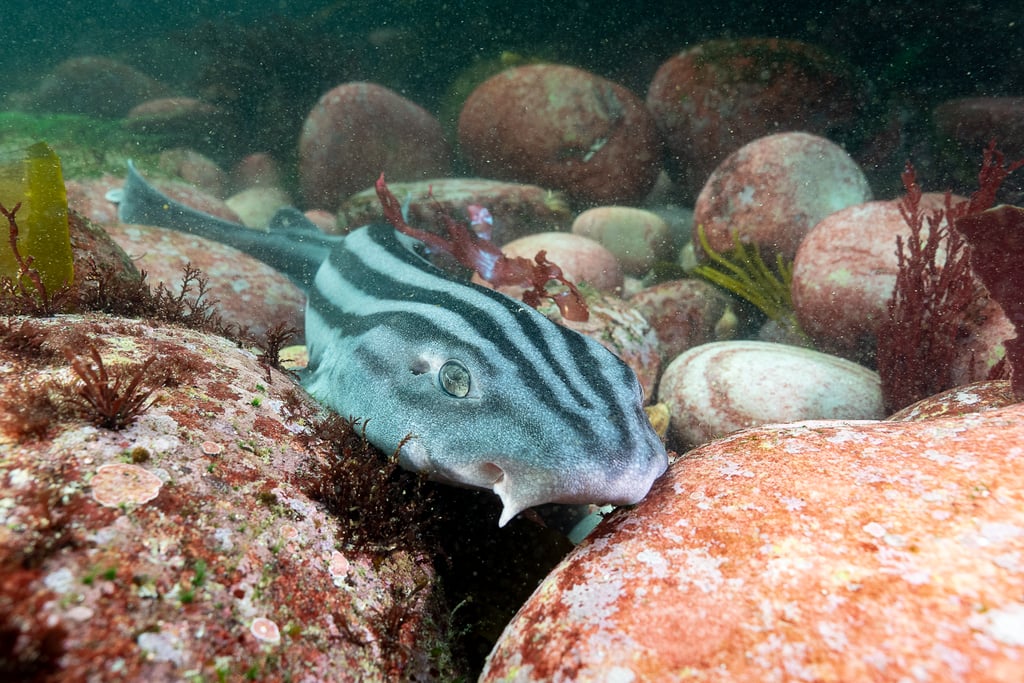
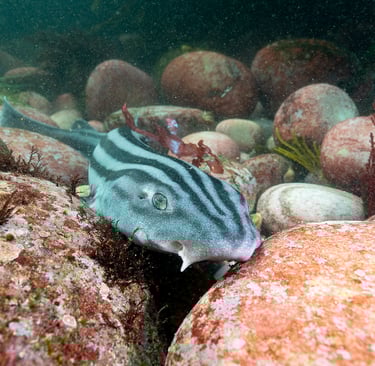
The monochrome conversion transforms everything. Suddenly, the shark's stripes become the dominant visual element. The textural relationships between smooth shark skin, rough barnacle-crusted rocks, and delicate algae creates beautiful contrasts that tells the adaptation story more powerfully.
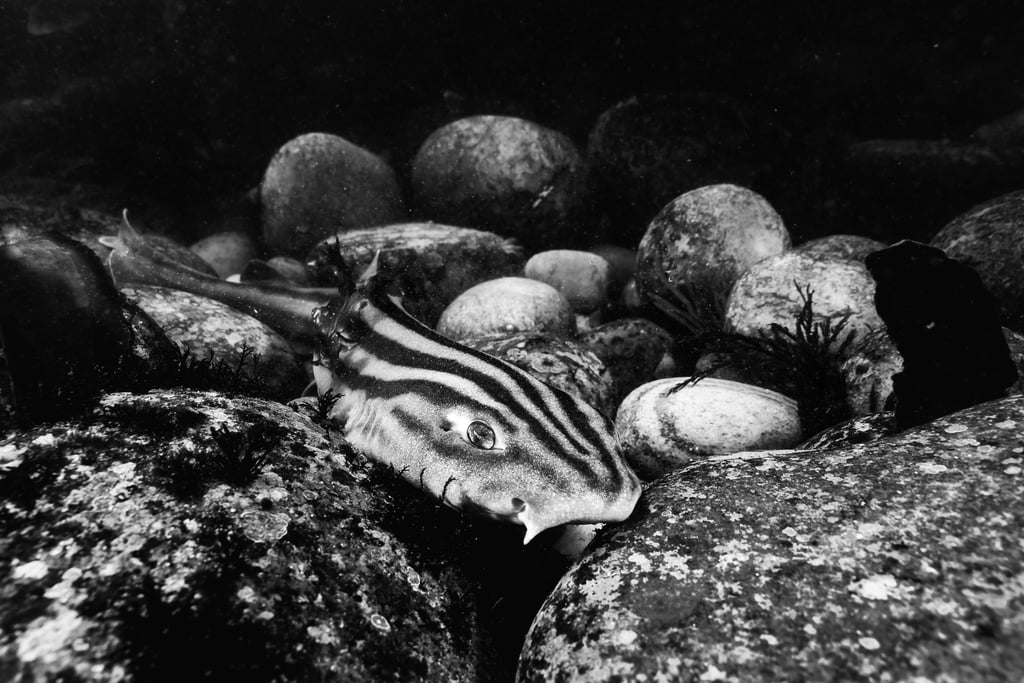
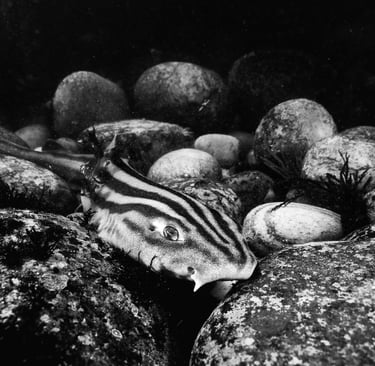
The Technical Lesson: By shooting in color but planning for monochrome, I tried to capture:
Full spectral information in the red rocks that translates to rich mid-tones in B&W
Green algae details that become subtle textural elements rather than colour distractions
Natural blue-grey shark tones that maintain perfect contrast against the converted background
This approach provides maximum flexibility in post-processing while ensuring that tonal relationships work harmoniously in the final monochrome image.
The Biological Revelation: In monochrome, the shark's stripes become the star. These aren't just decorative markings; they're sophisticated camouflage technology. The high contrast black and white treatment mimics how predators and prey see underwater, where contrast and movement detection matter more than colour recognition.
Compositional Techniques That Enhance the Story
1. The Rule of Negative Space
Notice how the shark occupies roughly one-third of the frame, with the surrounding rocks creating a sense of breathing room. This isn't just pleasing composition, it demonstrates the shark's relationship with its environment. The empty spaces reveal that this creature requires space to move, yet chooses to rest in tight, protected areas, typical of this endemic South African species.
2. Leading Lines Through Texture
The varied rock surfaces create subtle leading lines that draw your eye to the shark, then around the frame. This mimics how a predator's eye would scan this environment, following contours and shadows where prey might hide.
3. Depth Through Layering
Multiple planes of rocks create depth, showing how kelp forest floors aren't flat hunting grounds but complex three-dimensional spaces. The shark has positioned itself perfectly within this maze, close enough to ambush prey while being protected enough to avoid larger predators.
The Biological Story Hidden in Plain Sight
Adaptive Camouflage in Action
Those distinctive stripes that give pyjama catsharks their name aren't random. They break up the shark's outline against the dappled light filtering through kelp canopies above. In this photograph, you can see how the alternating light and shadow on the rocks would render a striped shark nearly invisible to both prey swimming above and predators scanning from the side.
Body Language of a Patient Hunter
The shark's posture tells a story of energy conservation. Notice how it's settled into the contours of the rocks, not fighting the current or actively swimming. This is a predator that has evolved to wait sometimes for hours for the perfect opportunity to attack small fish, cephalopods or crustaceans.
Habitat Selection Mastery
The shark hasn't chosen this spot randomly. It's positioned:
Between rocks for protection and ambush potential
On a varied substrate that matches its stripe pattern
In a location where the current likely brings scent trails of potential prey
Fine Art Interpretation: What Makes This More Than Documentation?
The Emotional Narrative
This image challenges our shark stereotypes. Instead of a fearsome predator cutting through open water, we see a creature that's almost meditative in its stillness. The composition invites contemplation rather than fear.
Textural Symphony
Every surface tells a story; smooth textured shark skin contrasts with rough barnacle-crusted rocks, creating a tactile quality that draws viewers in. This textural richness transforms a simple wildlife shot into a work of fine art.
The Mystery Element
By showing the shark at rest rather than in action, I attempted to create narrative tension, such as What is it waiting for? When will it move? This temporal ambiguity gives the image lasting power.
Photography Lessons for Marine Environments
Working with Available Light
Underwater photography often involves working with the ambient light that penetrates the water. I used the natural spotlighting effect of filtered sunlight to create drama without artificial strobes that might disturb the subject. This means I can get closer. Free diving also limits disturbance, with no bubbles from the tank. However, diving continuously, waiting minute after minute for a composition that I had imagined, is hard work.
Patience Mirrors Subject
Capturing a pyjama catshark's natural behaviour requires adopting their mindset, patience. This image required extended observation time, waiting for the perfect moment when shark, lighting, and composition aligned (approximately 2 hours spent working on a specific area).
Environmental Context
Rather than isolating the subject with a tight crop, including the rocky habitat tells the complete story. The environment becomes a character in the narrative, not just a backdrop.
The Bigger Picture: Conservation Through Art
Images like this serve conservation by changing perception. When we see sharks as complex, adapted creatures living in intricate ecosystems rather than mindless predators, we're more likely to protect their habitats.
The artistic quality ensures the image gets seen and remembered, while the educational content ensures viewers learn something meaningful about marine ecosystems and adaptation.
Technical Takeaways for Photographers
Pre-Visualization with Purpose:
Shoot in color, think in monochrome - capture full spectral data for maximum post-processing flexibility
Study tonal relationships while shooting - how will these colours translate to grayscale values?
Consider contrast mapping - vibrant reds become rich mid-tones, greens provide textural detail
Composition:
Use negative space to show environmental relationships
Let subject behaviour guide framing choices
Plan your monochrome conversion while composing. What elements will become dominant?
Underwater Considerations:
Work with natural light patterns for drama where applicable (kelp forests are great for natural dappled light, light rays and moody atmospheres.
Include habitat context for storytelling
Respect animal behaviour, don't force action shots, be there, be minimalist in your behaviour and the shot will come…. Or not, either way appreciate your surroundings.
Capture full tonal range even if planning B&W conversion
The Colour-to-Monochrome Workflow: This comparison illustrates why shooting in RAW colour provides the best foundation for artistic monochrome conversions. The warm rock tones, cool water, and varied algae colours all contribute different tonal values that create the rich contrast range in the final black and white image.